

Spring flowers in the Mani
read time: 5 mins
My Top 10 Spring Flowers
There are about 1800 different flowering plants recorded for the Mani; I have selected 10 flowers to be found in the spring in the Mani which are striking and interesting. The best flowering period is March-April, but some plants flower even earlier depending on the season. All the selected plants are relatively common and I have given some guidance of where to find them.
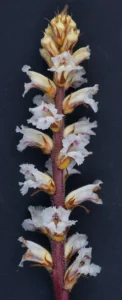
1. Orobanche crenata
The common name for this group of plants is Broomrape. They are often mistaken for orchids, but are in fact parasitic plants feeding off the roots of other plants. There are a few different species of broomrape in the Mani, but O. crenata is by far the commonest. Because it is a parasite and does not need to make its own food it has no green leaves with its leaves reduced to small brown scales on the stem of the inflorescence. The flowers are fragrant smelling of cloves. It can be found in many habitats, even on waste ground in villages.
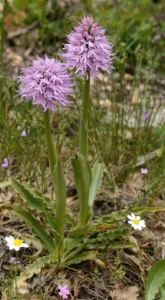
2. Orchis italica
The common name for this orchid is Naked Man Orchid Man Orchid and close inspection of a single flower will quickly reveal why it has this name. The orchid family is the largest plant family, with representatives on every continent except Antarctica. italica is not uncommon in the Mani, but a good place to find it is between Proastio and Petrovouni. The plant has a basal rosette of spotted leaves.
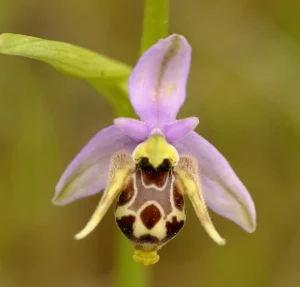
3. Ophrys scolopax ssp. cornuta
This plant is one of the bee orchids and its common name is Horned Bee Orchid, obviously derived from the long projections on the flower. There are a number of bee orchid species in the Mani, but scolopax is probably the commonest. The appearance of bee orchid flowers is very variable from season to season although they are perennial and have an underground tuber. The flowers are designed to mimic insects and attract them as pollinators. The orchids have an interesting modification of the pollination mechanism, rather than producing individual separate pollen grains they are packaged in sticky packets called pollinia which stick to the back of insects visiting the flowers. Because the flower patterns of the bee orchids are so variable they have attracted a multitude of different names, but there are probably about 20 species in Greece. Bee orchids can be found in a variety of habitats but the basic requirement is for surrounding vegetation not to be too tall.
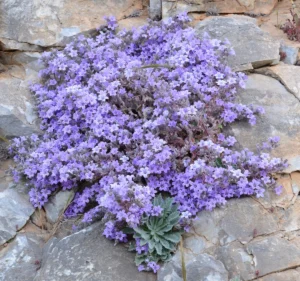
4. Campanula topaliana
This plant is a biennial, producing a rosette of leaves in the first year and flowering in the second year. It does not have a common name and one of the best places to find it is growing on the cliff faces beside the road between Agios Dimitrios and Trachila.
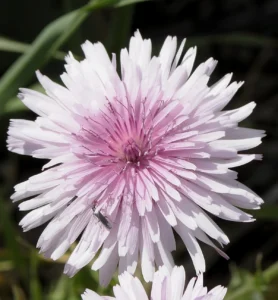
5. Crepis rubra
Pink Hawksbeard is a member of the daisy family, but is rather unusual in having pink flowers when many plants in the family have yellow flowers. It occurs in many habitats often as dispersed plants but sometimes in big communities providing a striking display.
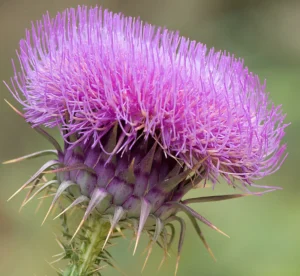
6. Onopodum tauricum
This giant thistle is up to 2 m tall with large purple flowers. A stand of this plant is an impressive sight and can be seen along roadsides particularly in the deep Mani. It flowers a little later in the year being in full flower in June and is widely distributed in Greece.
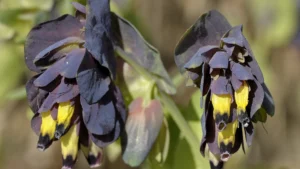
7. Cerinthe retorta
The common name of this plant is Honeywort and it is a member of the borage family. It is named for its production of honey flavoured nectar which attracts insects. It is a striking plantwith yellow tubular flowers with a dark purple tip surrounded by dark purple bracts (modified leaves). It does not grow at lower altitudes and you have to go up to the mountain villages to see it along the roadsides.
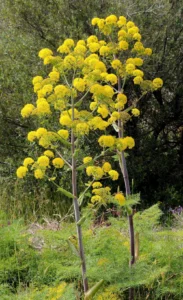
8. Ferrula communis
Giant Fennel is a spectacular plant growing to more than 2 m tall with a large compound inflorescence composed of a myriad of small yellow flowers. It is often locally abundant and can be seen along the road into Trachila and beside the road just before you enter Areopolis from Oitylo.
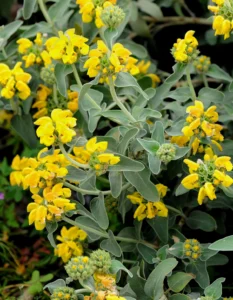
9. Phlomis fruticosa
Jerusalem Sage A shrubby aromatic plant with showy helmet shaped yellow flowers. This plant is very common along roadsides and in the shrubby vegetation called phrygana and can be found at all levels down to the coast
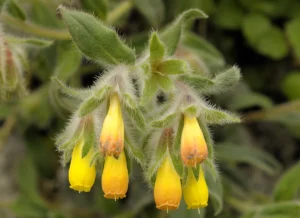
10. Onosma frutescens
Another member of the borage family and the commonest of a number of different species of Onosma in the Mani. It is found growing on rock faces and has pendant, tubular yellow flowers tipped with orange. It is a very hairy plant covered with simple unbranched hairs. It can be seen in the Virou Gorge or on the cliffs along the road to Trachila.
For those readers who wish to explore the flora of the Mani more fully there are two books devoted specifically to the plants of the Mani. These are the only publications which focus on this area in particular.
Wild Flowers of the Mani – Over 900 species are described each with an illustration and a short description.
Pictorial Flora of the Mani (3 volumes) – over 1300 species are described with a page devoted to each species showing various parts of the plant, a full description, flowering time and distribution. In addition the volumes contain pictures of various locations in the Mani and animals found locally together with other decriptive material.
The books are available in stock in bookshops in Kardamyli, Agios Nikolaos and Areopolis or direct from the author at -maniatis@btinternet.com
0 Comments