
The Little White Book
read time: 5 mins
A personal journey into exploring a Maniot family tree
There is a wealth of literature about Mani and the Maniots, for reasons which are easily understood. The entire Mani peninsula in the southern Peloponnese, on the outskirts of the old Greek kingdom of Morea, is like an open-air museum, inhabited for centuries by warring tribes who shunned slavery, political tyranny and never submitted to written laws. A free people who were connected to the land, were late converts to Christianity, protected their blood lines and engaged in epic vendettas. As many Hellenic scholars have noted, there is much beauty and mystery entangled here, from medieval times and even earlier.
This rich history deserves to be investigated and preserved – a view I hope will persuade you to join me on my very personal pilgrimage.
The Little White Book
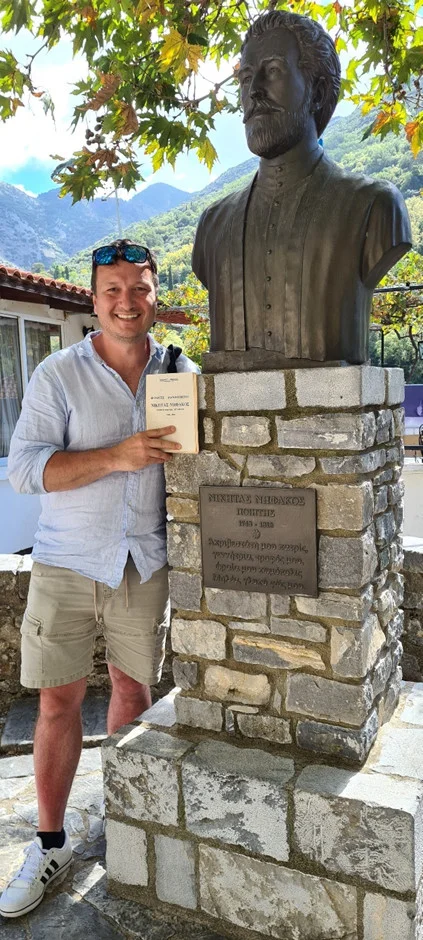
My connection to Mani is through my father, Dionysios Nifakos, and, further back, his ancestor, Nikitas Nifakos, the national poet from the Mani. When I was growing up in Australia, my father and his siblings would talk with passion and pride about the little village of Milea, tucked away in the mountains, the village from which the Nifakos clan originated. They also constantly referred to a little white book as a revered source of truth on everything to do with family history, (predictably, I suppose, it only followed male members of the clan so that discussions amongst the elders about other distant relatives easily led to acrimonious exchanges!). I inherited this little white book and was gob smacked when I translated it. Absolutely mind-blowing. I never knew our family tree could be traced back – with evidence – to the year 1697, a 300 year plus history. To put it in context, Australia was discovered by the British in the year 1788.
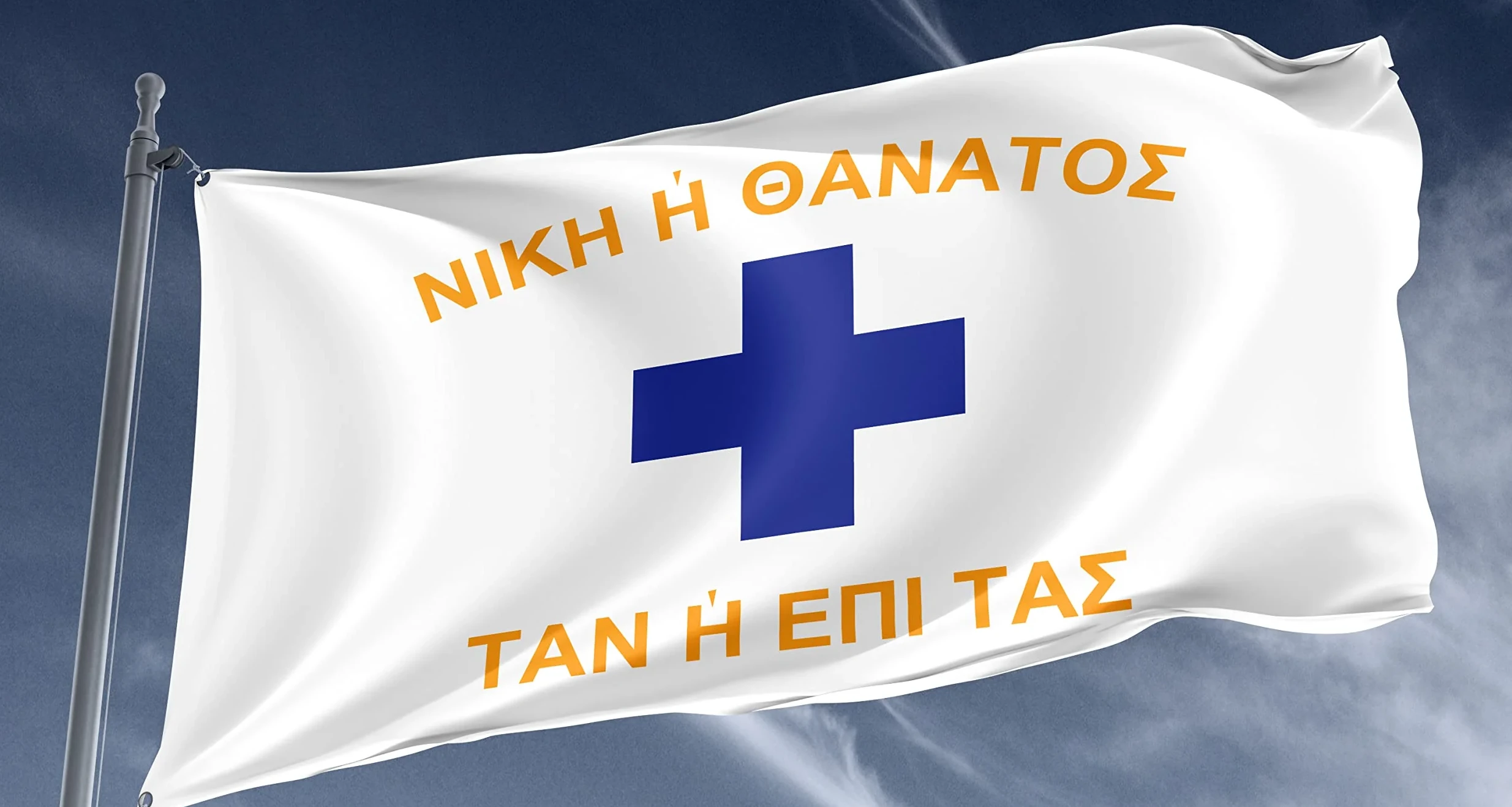
“As I began my family pilgrimage , the famous revolutionary slogan of the area ‘ΝΙΚΗ Η ΘΑΝΑΤΟΣ’ aka ‘Victory or Death’ was my mantra”.
With the passing of my father, I decided to pay homage to his beloved Greece and in particular the village of Kato Hora in Milea on the west side of mount Taygetos. By the time I left Australian waters, I was well versed in the origins and history of Mani, the culture, the geography, its food, its people and our family tree. I was raring to go, a quasi-Indiana Jones ready for adventure but instead of a fedora and whip, I had a smart phone and my little white book of truth. As I began my family pilgrimage , the famous revolutionary slogan of the area ‘ΝΙΚΗ Η ΘΑΝΑΤΟΣ’ aka ‘Victory or Death’ was my mantra. I had a newfound sense of honour and admiration after digesting the history of the extended Nifakos clan that had preceded me; it spawned polymaths of every description: teachers, scientists, high-ranking military officials, lawyers, doctors and priests (who interestingly helped make explosives from goat dung – a decent source of nitrogen, phosphorous and potassium oxide- quite the savvy alchemists!).
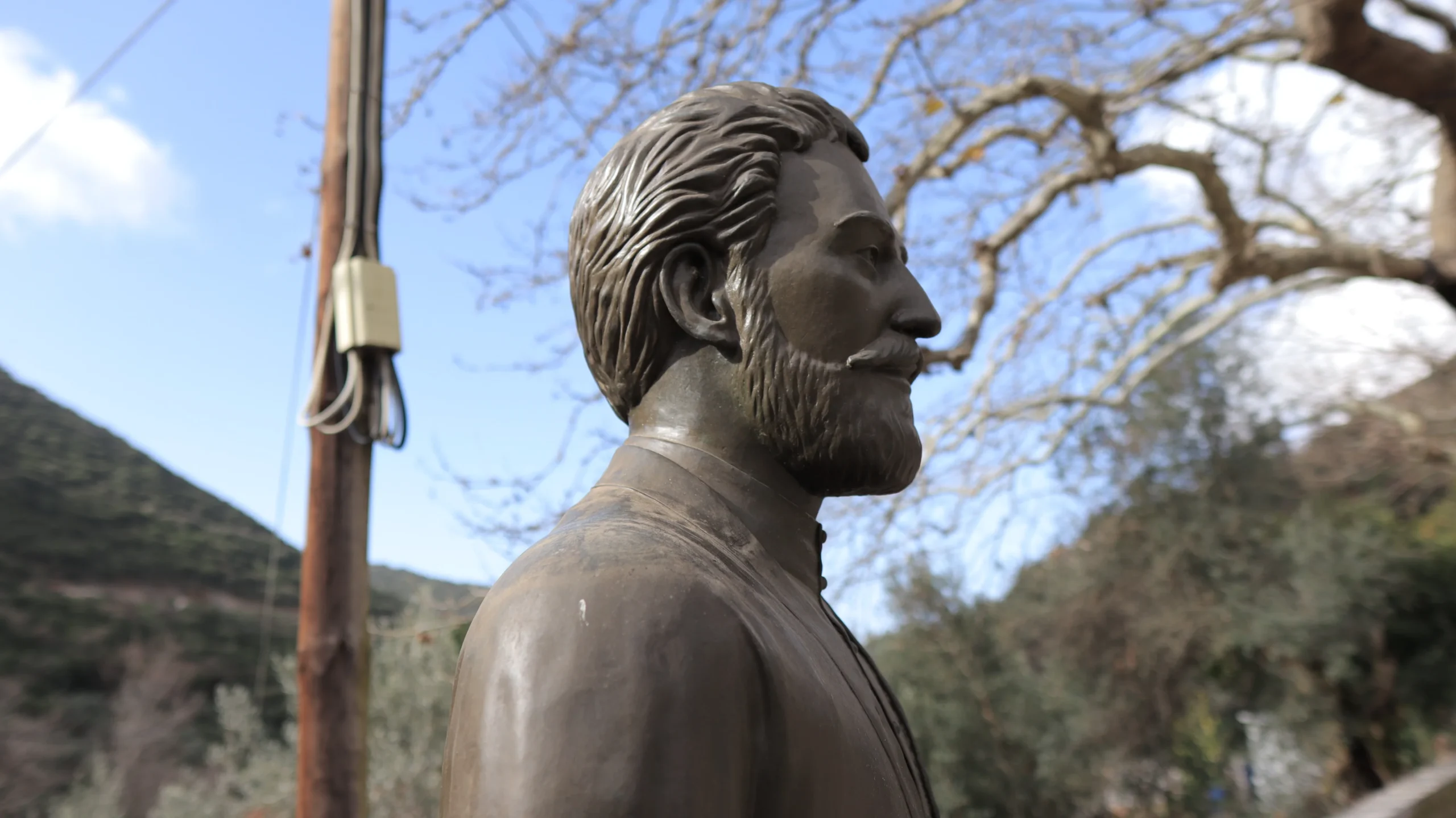
But a person of special interest to me was obviously going to be the poet, Nikitas Nifakos. My father was my anchor, the poet our most illustrious ancestor. His was the era of the klephts: an era of pirates, mercenaries and vendettas. For those unfamiliar with the term klepht, they were self-appointed anti-Ottoman insurgents: the freedom fighters of their day. This region of Greece was feared and loathed by many, unconquerable by any who came. Nikitas Nifakos wrote ballads in which he captures the mood of the age, fusing political and peasant events, always using the conventions of decapente verse (fifteen syllables per line). His descriptive awareness and verse scheme are what gave him his kudos as a poet. He is immortalised by a bronze statue erected in August 2013 in his home village of Kato Hora, Milea, created by Nikolaos M. Bokeas.
This statue was going to be an obvious focus of my first early morning visit to Milea, but first I decided to walk over to the church of Metamorphosis which dominates the main square of Milea. As I looked more closely at its decoration I was struck by how openly they had blended pagan and Byzantine themes. Chiseled sun discs and various animals sit next to wings of angels and the equal-armed Greek cross. It’s a fusion of the religious and the secular (not natural companions) which you will find adorning many churches and pyrgoi (tower-houses) in the Mani. Even Panagia Yiatrissa, high up on the crest of Milea, is believed to be built on top of a pagan shrine.
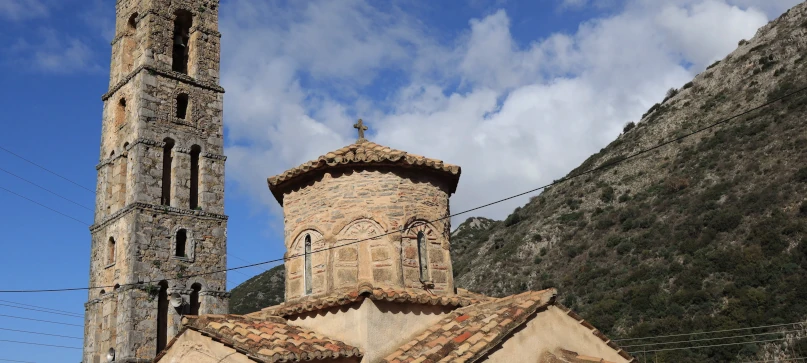
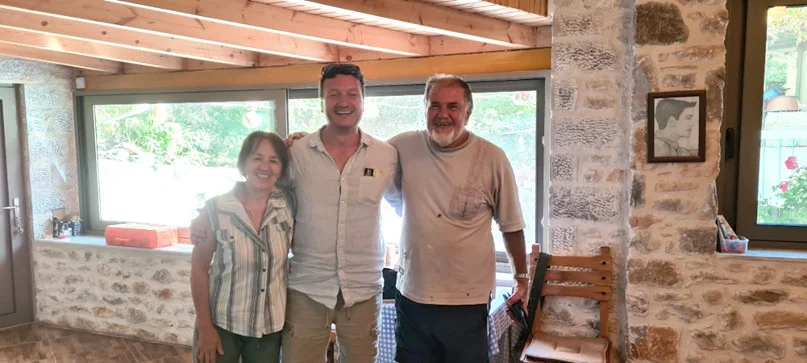
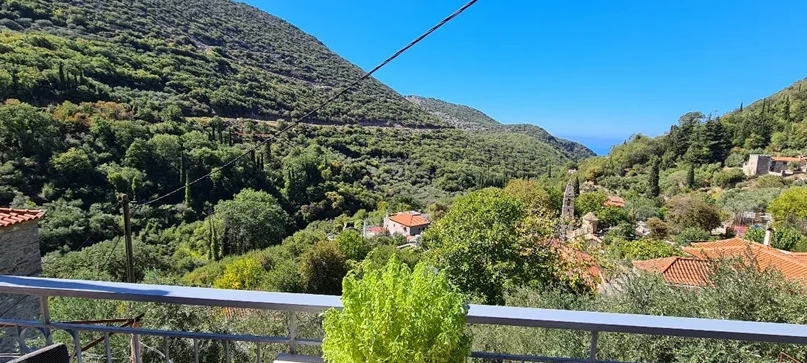
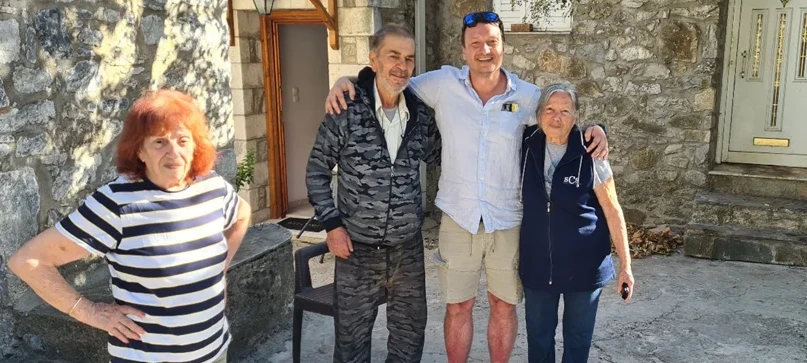
On that first visit to Milea I spotted a local woman coming out of her front door and decided to greet her in my broken Australian Greek. Warm and welcoming, her eyes darted straight to the little white book in my hand and she smiled. I asked her for directions to the church of the Dormition of the Virgin Mary which I knew was the “Nifakos” church. With obvious pride she replied ‘yes, follow this road, see that tower, that’s it……and by the way, I’m a Nifakitsa too!’ Oh, how awesome – my first long lost relative. She immediately got in touch with another Nifakos living in the village and before I had time to draw breath I found myself sitting on his balcony with a frappe provided by his wife- along with the obligatory ashtray. ‘We all have that little white book, you know’ he said, smiling. He pointed to Kato Hora, the lower section of Milea, from his balcony, “you come from down there and one third of this village, from that ridge to this big tree, belongs to members of the Nifakos family”. I was humbled and speechless. And it just went on. I trotted off down to Kato Hora to see the birthplace of Nikitas Nifakos and the significant statue commemorating his life, the home where my great-grandfathers grew up, only to be greeted by yet more welcoming smiles and invitations. I had my driver’s licence (Australian training) and my little white book ready to prove my credentials, but they were waved away: the locals had already called round with the news – a new Nifakos was in town! More locals came out, more connections were made, more stories told. Nifakos Nifakos everywhere. This was proving to be such a good birthday present to myself, a trip full of wonder and emotion. Sigh -that little white book had been a revelation. Thanks, Dad.
The sun was setting and my head was reeling with all the information I now had – good, wholesome information- but before I could roll another cigarette and make my farewells, I found myself loaded with gifts of local honey, fruit and nuts. Those simple gifts somehow summed up the whole experience – even though my head was saying I had a lot of eating to do because Australian customs ain’t letting you through with all this stuff!
The 2 books on the Mani I cherish the most:
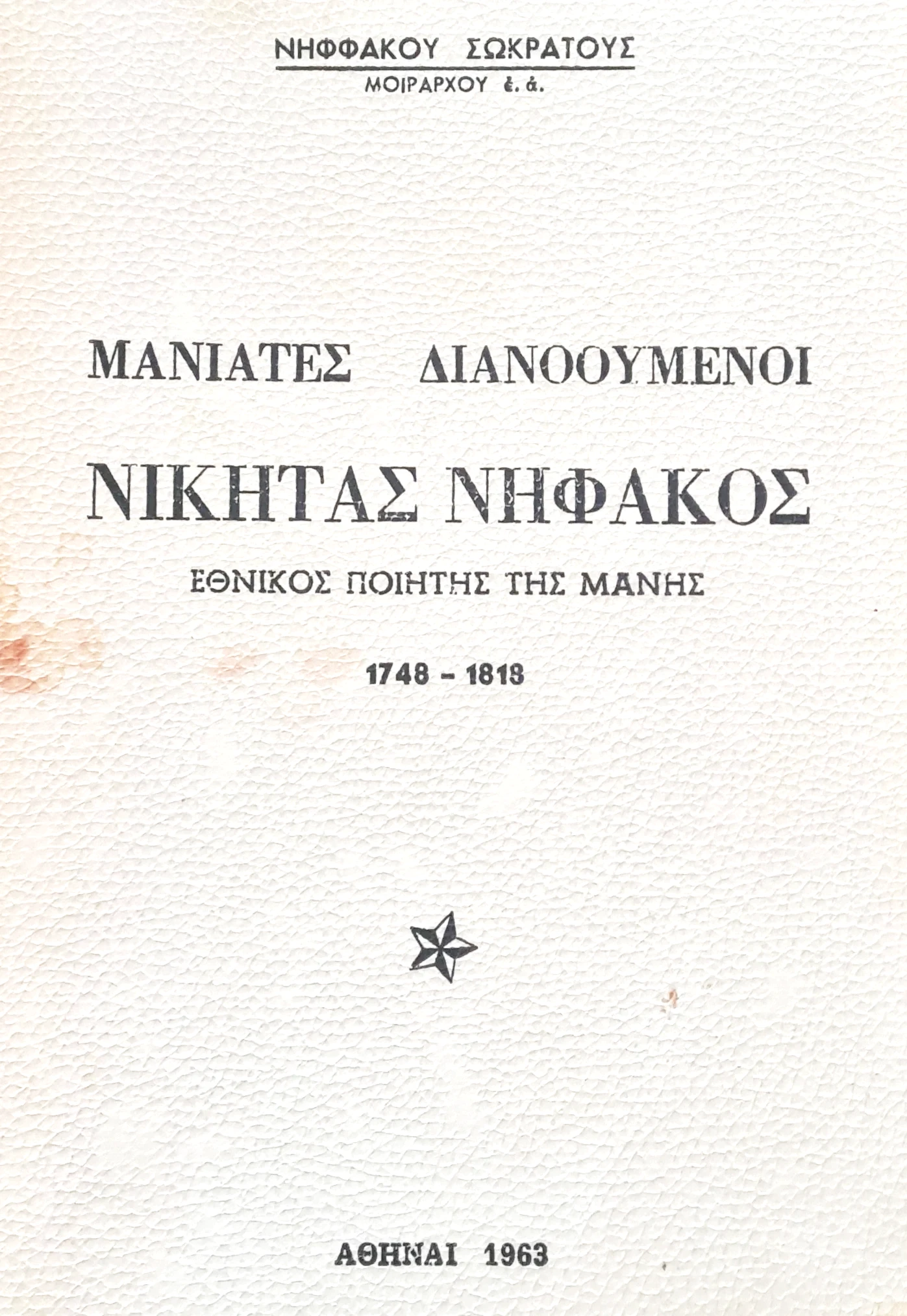
The “Little White Book”
Nikitas Nifakos, National Poet of Mani 1748-1818 by Socrates Nifakos, Athens 1963.
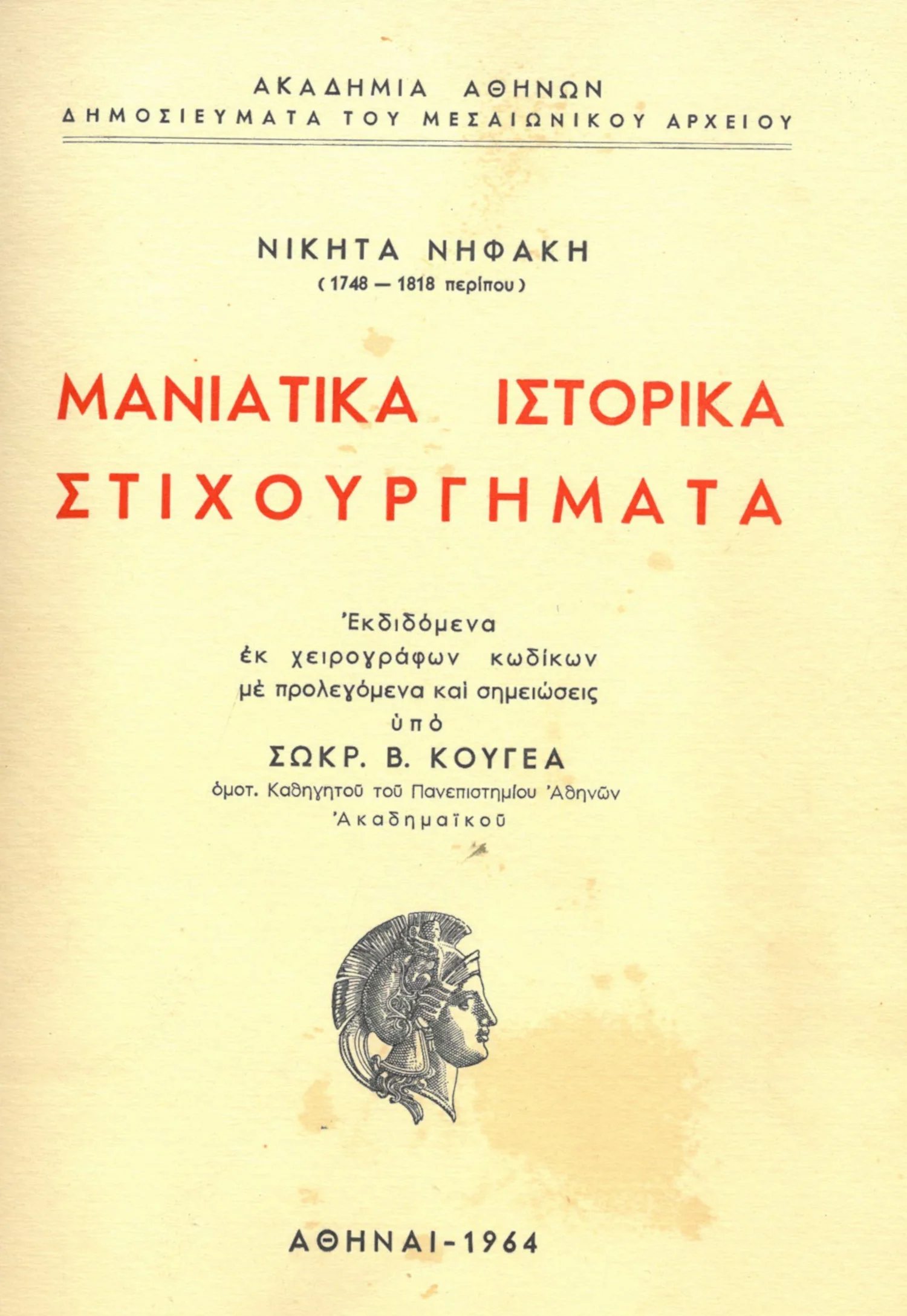
Maniot Historical Poems
by the academic Socrates Kougeas, who published Nifakos’s handwritten poems in 1964.
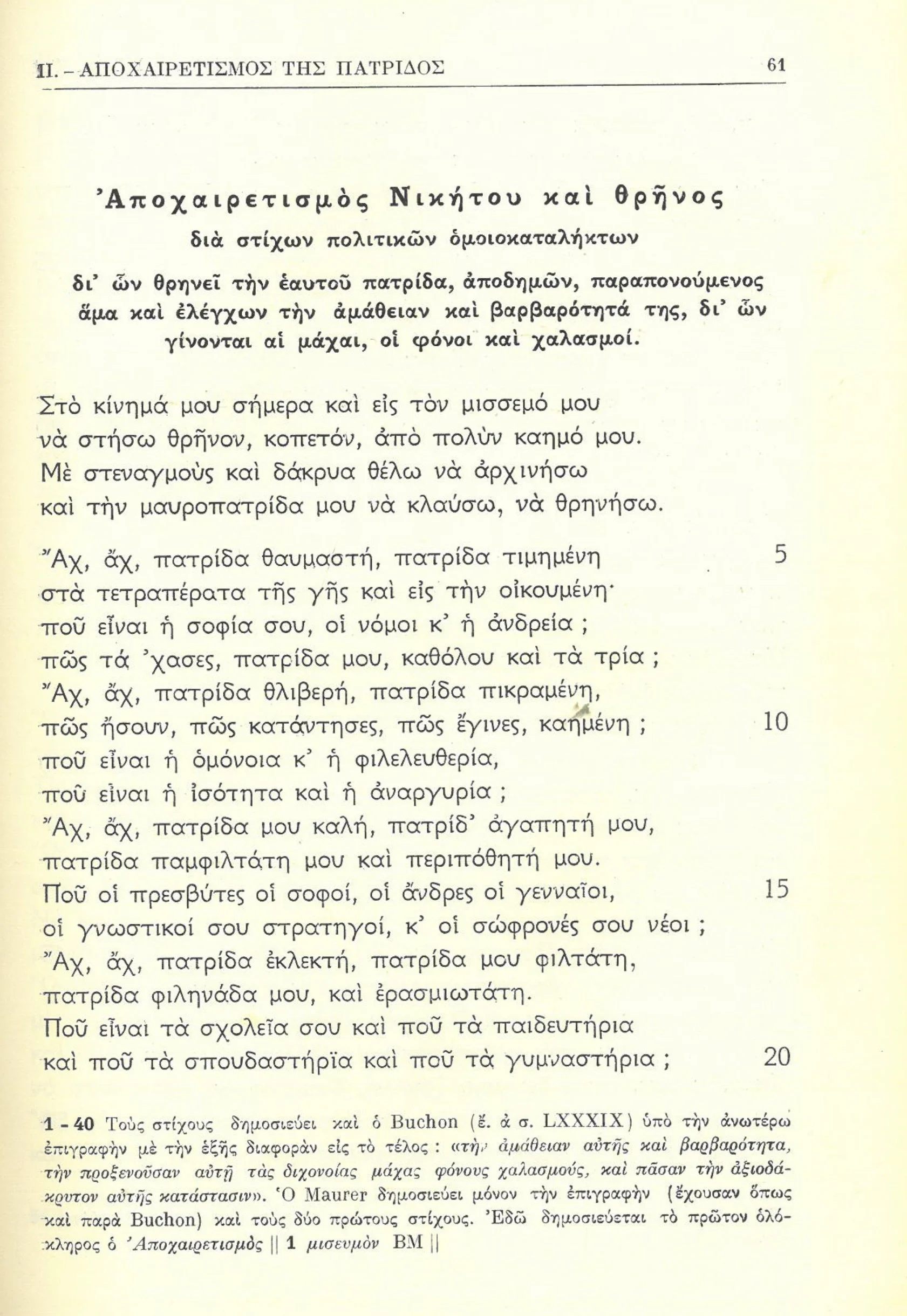
" A Farewell Lament "
Nikitas Nifakos, the opening 20 lines of a 160 line poem. A rough translation follows….
Note: Anyone with a little knowledge of modern Greek can detect the original Καθαρεύουσα verses were written in the traditional dekapente format (fifteen syllables per line) with each pair of lines rhyming. Composed in the late eighteenth century, they reflected the feelings of despair and anger felt after seemingly endless years of Turkish occupation. In exile he grieves for his homeland and criticises the ignorance and barbarism which caused the battles, the slaughter and destruction.
Nikitas Nifakos - " A Farewell Lament"
In my isolation and profound distres, I will today compose my seething laments,
With sighs and tears I start to mourn and to grieve for my wretched country,
Oh, oh, my wonderful country, revered in the four corners of the inhabited world, where are your laws, your wisdom and your courage? How did you lose all three?
Oh, oh, my sad country, my bitter land, how did you fall so low, become so wretched? Where is your unity, your love of freedom, where is your equality, your charity?
Oh, oh, my beautiful country, my beloved country, my dearest homeland, where are your wise elders, your noble men, your famous generals, your able young men?
Oh, oh, my chosen land, my dearest homeland, my most precious country, where are your schools, your kindergartens, your reading rooms, your training grounds?
I am still processing my visit to Milea and Mani. It certainly had a profound effect on me. Why did I not pay more attention to the conversations of Dad and the elders when I was young? Quite possibly because colourful Lego blocks were more appealing than late night card games, cigarette-filled rooms and whisky. But at least I now understand my father’s deep love for Milea and the Nifakos name: to him they helped shape and liberate his beloved Greece. And I shall go again, not least so that I can join in the feast held on August 15th to honour the Virgin Mary. Locally Milea is known as ‘the two day panigyri village, up the top’ which just leaves you smiling – what on earth do they get up to in such a small place? Apparently people come from everywhere; they attend the church service at Panagia Yiatrissa, then party for two days…..
Meanwhile I will content myself with playing some of my father’s favourite rebetika songs and order a plate of siglino (smoked pork infused with orange fruit dressing). A good Maniatiko signature dish.
WRITE YOUR OWN ARTICLE & GET A FREE YEAR'S SUBSCRIPTION!
Have you got something Mani-related to say, enjoy writing and would like to be a part of this new site? We’d love hear from you as we want this site to be yours, not ours- why should we always be the ones to decide on the magazines’ content? And in the process, you get a year’s FREE membership to the site.
If you’re interested in being involved, you could email your idea directly to mat@insidethemani.com but it may be more time effective if you first read some suggestions and FAQ’s HERE.