

New national map shows seismic hotspots
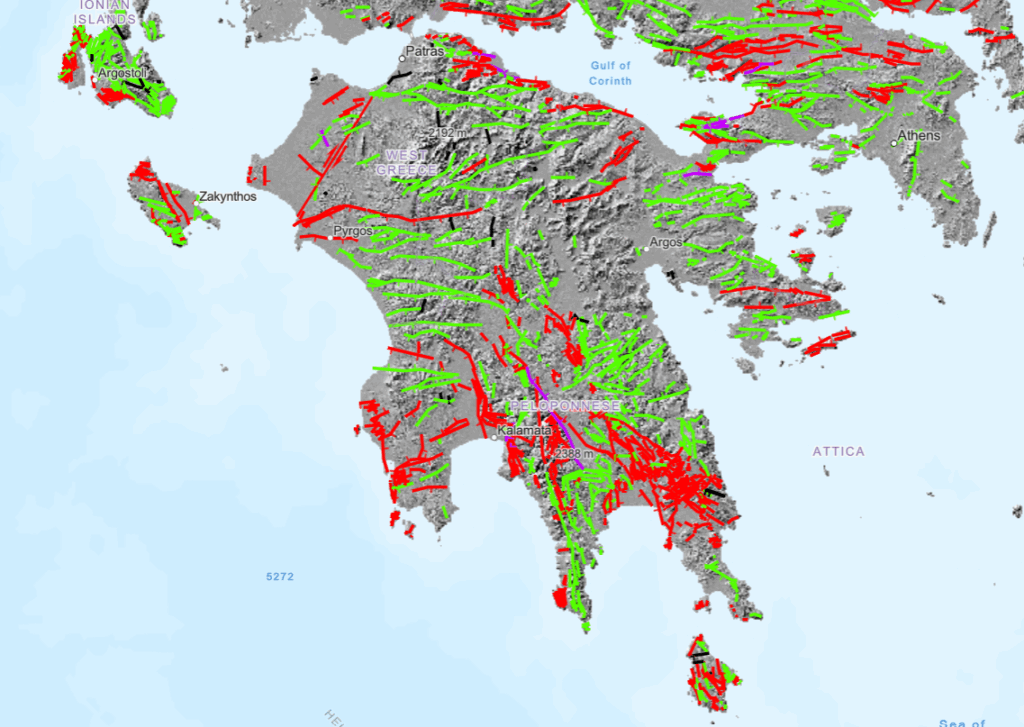
Tharros reports that a new map is now available that comprehensively details the severity of seismic activity in our region and throughout Greece.
Greece, a country that lives and breathes on active geological boundaries, now has the most complete and detailed map of active faults ever recorded. Researchers from the National Observatory of Athens, in collaboration with scientists from New Zealand, systematically mapped the entire land territory, revealing hundreds of hitherto unknown faults and capturing with unprecedented accuracy the already known ones.
This new database, entitled Active Faults Greece (AFG), was published in Scientific Data and aspires to change the way we perceive seismic hazard in the country.
The geological “machine” behind the Greek landscape
As the international team of Dr John Begg, Dr Vasiliki Mouslopoulou, Dr Dave Heron and Prof. Andy Nicol explains, the geodynamic position of Greece – between the African and Eurasian plates – makes the country one of the most seismically active regions in Europe. The terrain we take for granted today, from the high peaks to the valleys and the hills, is the result of an uninterrupted geological process that has been going on for millions of years.
However, many of the active faults remain “hidden”: under dense vegetation, in man-made interventions or in complex geomorphological forms. This is exactly where the technology: using detailed Digital Terrain Models (DEMs) from the Hellenic Cadastre, scientists were able to read the relief in depth, as a geologist would read an ancient manuscript.
What the new database reveals – The overall map
AFG records 3,815 fault traces, grouped into 892 active, possibly active, or uncertain faults. More than half of them appear for the first time on a scientific map. Nearly 2,000 of them are classified as active, while more than 1,600 are classified as possibly active.
Important element: more than half active faults are directly related to the morphology of the Greek landscape, deviations rivers, steep slopes, “triangular” mountains, geological signatures that testify to earthquakes of the past.
Looking at Messinia
The new recording acquires particular importance for Messinia, a prefecture that is often characterized as “quiet” in terms of catastrophic earthquakes, but remains active and geologically dynamic. AFG’s map reveals a complex web of faults, some known from earlier studies and others now clearly depicted for the first time.
The area from the Messinian Gulf to the West Mani shows a very intense disruptive activity, which is historically related to with earthquakes that have affected Kalamata and the surrounding areas. Especially the eastern side of the Messinian Gulf, towards Mani and Taygetos, actively includes faults that seem to control both the morphology and the flow of streams.
Inland, towards Meligalas, Thouria and Arfara, the New mapping highlights traces of possibly active faults that have not yet been were captured in so much detail. Although not necessarily associated with major historical events, their existence is crucial for infrastructure projects such as the new highway, the bridges of Pamisos and the energy networks.
Central Messinia, with its coastal zones to Kyparissia, Filiatra and Gargalianoi, also has scattered traces faults – some active, others possibly active – which form the boundaries of the between hills and plains. The area has experienced earthquakes in the past, but AFG gives such a detailed depiction of the subsoil for the first time.
The scientific and social importance
As Dr. Vasiliki Mouslopoulou emphasizes, this mapping has direct consequences for infrastructure, urban planning and, of course, seismic shielding. From the roads of Messinia to dams, new energy installations and developing tourism, knowledge of active faults is a tool that – if used – can reduce risks and uncertainties.
Dr John Begg recalls that “technology from alone is not enough.” DEMs need the interpretation of people they know to read the landscape. The combination of digital tools and scientific experience makes AFG unique in accuracy and reliability.
A tool open to all
The new database is freely accessible online. Engineers, researchers and citizens can now accurately locate faults in their area, from Taygetos to the Messinian Gulf, from Pylia to Trifylia.
For an area like Messinia, where the urban growth, major projects and tourism are moving at a rapid pace, this Knowledge is not a luxury. It is a necessary infrastructure.
The new mapping does not promise to predict earthquakes, no science can. But it promises something more realistic and perhaps more valuable: a clearer picture of the ground on which we build our cities and our lives. And for Messinia, an area that has learned to live with seismic risk, this is an important step towards a more conscious and safe reality.
0 Comments