

Greek farmers continue blockades
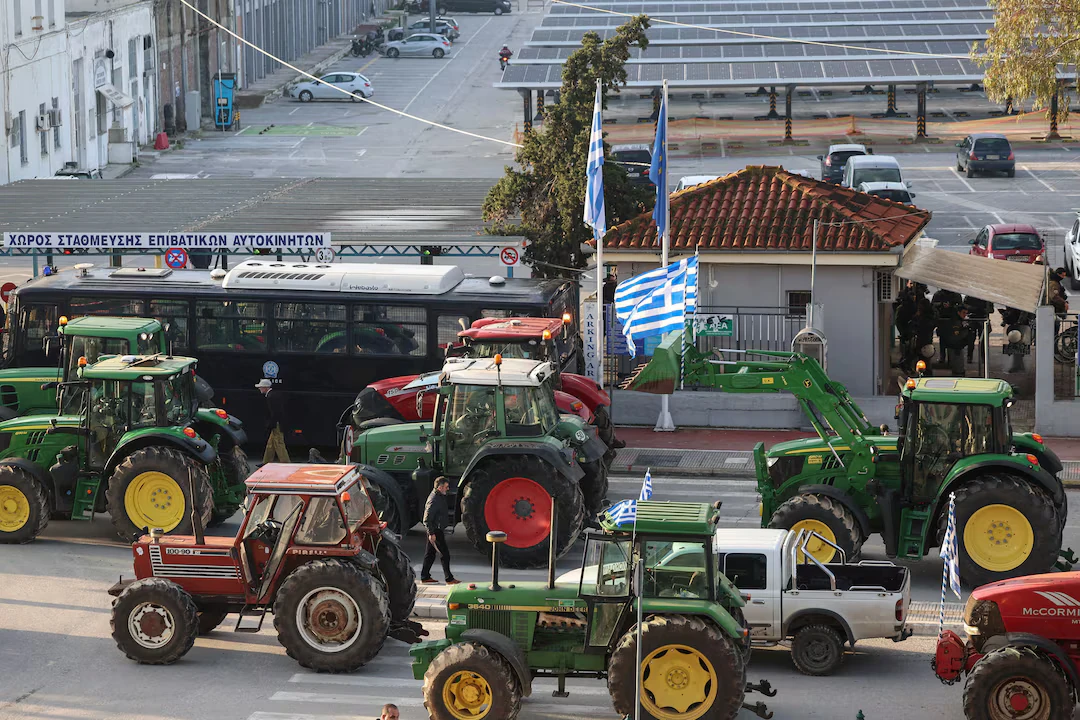
The stand-off between Greek farmers and the government continues with protests taking the form of blockading major road intersections throughout the country. If you’re planning a trip up to Athens, read on….
Main reasons for the blockades
- Delayed EU subsidy and government payments
A core demand of the farmers is the release of delayed agricultural aid – mostly EU farm subsidies and state compensation. Payments have been held up because authorities are conducting audits and investigations into a large subsidy fraud scandal, slowing down disbursements. - Corruption scandal in agricultural subsidies
In 2025 a big fraud case emerged where some farmers allegedly used falsified land-ownership and other documentation to obtain EU agricultural funds. This prompted official investigations, which in turn halted the flow of new aid payments to farmers while records are audited. - Rising production costs and economic pressures
Farmers are also protesting against high input costs (fuel, fertilizer, feed), which eat into their already thin margins. They want concrete measures to lower these costs and help keep farms viable. - Other agricultural hardships
Additional grievances include poor disaster relief after events such as devastating floods, and issues like animal disease outbreaks (e.g., sheep pox), which forced large livestock culls. These combined stresses have increased pressure on already struggling farmers.
How the protests are taking place
- Thousands of tractors and farm vehicles have been used to block major motorways, key intersections, border crossings (e.g., Kipi) and even port operations in places like Volos and Thessaloniki.
- Some protesters have attempted to block access to airports and national highways, leading to confrontations with police and legal actions
Government response and political context
- Authorities have threatened arrests, criminal prosecution, and are trying to balance enforcement with dialogue.
- The Prime Minister and government officials acknowledge payment delays but stress investigations are necessary and talk about negotiation.
- Impact
- The blockades are affecting transport, freight, winter tourism and general movement across the country.
- There’s solidarity from other groups, including some unions and workers, connecting farmers’ protests to broader economic concerns.
Tharros News reports in detail on how the main Kalamata – Athens motorway is being effected- something you should know if you’re planning a trip to Athens.
“Traffic regulations on the motorway due to the agricultural mobilizations
Temporary traffic regulations were implemented by the General Regional Police Directorate of Peloponnese on a section of the Corinth-Tripoli-Kalamata motorway and the Lefktro-Sparta branch, due to the agricultural mobilizations.
These arrangements, which will be in effect for as long as necessary, are as follows:
- From km. 222.6 (Arfaron interchange) to km. 232.0, in the direction towards Kalamata, as well as on the exit branch on the Thourias – Messinis connecting road, there is a traffic interruption for all types of vehicles
- From km. 236.5 (Asprochomatos interchange) to km. 222.6 (Arfaron interchange) in the direction towards Athens, as well as on the entrance branch from the Thouria – Messini connecting road, there is a traffic interruption for all types of vehicles.
During the temporary traffic regulations, all vehicle traffic will be diverted and conducted on the old Tripoli – Kalamata national road (remember this road?!).
0 Comments